
The five limits on AI infrastructure scaling
Scaling artificial intelligence workloads has turned digital infrastructure into a confrontation with physical limits, and those limits are the constraining factors shaping every AI data center built today. Grid capacity, regulatory approvals, supply chains, heat dissipation, and structural load all now cap how fast the industry can build, pushing the sector into a period of infrastructure scarcity that runs through at least 2030.
Land and silicon used to set the pace of growth. Now grid interconnection queues stretch past 80 months in Northern Virginia, thermal limits make air cooling physically impossible past 50 kW per rack, structural loads break traditional raised-floor design, and equipment lead times push transformer delivery past two years.
Understanding this scarcity can help developers, operators and tenants design, develop and operate better.
The Power Grid Wall and Interconnection Asymmetry
Why Is Utility Interconnection the Primary Bottleneck?
Old transmission networks have reached their operational limits. The build-first, connect-later model that defined the industry for decades no longer applies. Data center site value now depends almost entirely on how fast a project can secure power. Fiber backbone proximity, once the deciding factor, has become a secondary consideration.
Global demand explains why the pressure keeps building. The International Energy Agency reports that global data center electricity consumption reached 415 TWh in 2024, with its Base Case projecting this will surpass 945 TWh by 2030, a 15% compound annual growth rate 1. In the United States specifically, McKinsey & Company models a similar acceleration, forecasting data center power demand will climb from 25 GW in 2024 to more than 80 GW by 2030 2.
The US grid backlog exceeded 2.06 terawatts of queued interconnection capacity by the end of 2025, nearly double the country’s entire installed generation capacity 1, with a similar situation unfolding in Europe.
| Region | Grid Status | Wait Time | Specific Impact |
|---|---|---|---|
| PJM (Northern Virginia) | Over 130 GW of capacity-eligible projects queued | 48–84 months | Capacity auction prices pushed to $329–$333 per MW-day 1 |
| ERCOT (Texas) | Deregulated grid, still capacity-constrained | 20 months minimum; up to 48 months in high-growth zones | Large-load projects face the longest queues despite deregulation 1 |
| FLAP-D (Frankfurt, London, Amsterdam, Paris, Dublin) | Connection queues stalling projects outright | Up to 10 years (Amsterdam, Frankfurt) | Dublin under a grid connection moratorium (a freeze on new connections) through at least 2028, tied to data centers consuming roughly 21% of Ireland’s national grid 1 |
AI Workloads and Grid Stability Profile
Grid connection resolves only part of the challenge. Once power reaches the facility, AI clusters strain that connection in ways ordinary cloud workloads never did, across four operational parameters outlined in the table below.
| Operational Parameter | Cloud Workload Behavior | Accelerated AI Cluster Behavior | Engineering Impact / Mitigation |
|---|---|---|---|
| Load Dynamic How much the power draw fluctuates | Steady-state, predictable power draw. | Highly synchronized, bursty computing phases. | Sub-second transient power spikes surging 50% above baseline. |
| Grid Regulatory Risk How the load impacts grid planning | Minimal transient stress; high system predictability. | Violates standard static composite load models. | Mandates NERC Level 3 Alert compliance via PERC1 dynamic load models 3. |
| Power Quality How clean and undistorted the electrical signal stays | Operates near unity power factor with low harmonic injection. | Severe phase shifts; drops in lagging territories during training bursts. | Elevates Total Harmonic Distortion (THD). Requires Active Harmonic Filters (AHF). |
| Substation Integration How well substations can handle AI data centre bidirectional power flows | Standard electrical safety parameters. | Requires bidirectional grid interaction protocols. | Governed by IEEE 2800-2022 principles for fast frequency response and voltage ride-through 4. |
A transformer is built to handle steady, predictable current. GPU clusters send the opposite: power draw that spikes and drops in sync, thousands of times a second, and that mismatch damages equipment not engineered to withstand it.
High-density, non-linear GPU loads inject continuous harmonic distortion. That distortion carries a real cost: transformer de-rating. Standard utility substation transformers weren’t built to absorb the eddy currents and stray load losses produced by 3rd, 5th, and 7th order harmonics. To avoid thermal runaway and insulation failure, operators de-rate a 10MVA transformer down to just 6.5–7MVA, following capacity calculation methods set out in IEEE C57.110 5.
K-Factor transformers address this issue at its origin. GPU power supplies generate harmonics that pile up in the neutral wire instead of canceling out, the way current from an ordinary, balanced load normally would. A standard neutral wire isn’t built for that extra current and overheats. A K-Factor transformer uses a thicker neutral wire, rated to carry twice the normal load, so it can absorb that pile-up without overheating.
The constraint lies in availability. K-Factor units run through the same manufacturing bottlenecks squeezing every large transformer order right now, shortages of Grain-Oriented Electrical Steel (GOES), the specialty steel used in transformer cores because its grain structure is aligned to minimize energy loss, and limited winding capacity, so lead times track the broader market’s 100 to 128 weeks rather than offering a faster path 6.
Local site considerations
Land and power are only the starting point for building an AI data center. Permitting is where infrastructure scarcity turns into a social and political problem, not just an engineering one. Every project still has to clear a local permitting process, and that process increasingly runs through public hearings where residents, not engineers, decide whether construction moves forward.
Why Permits Get Denied?
Data center proposals now fail for reasons that have little to do with engineering. Four patterns show up repeatedly across 2026 rejections and moratoriums.
- Procedural defects in public notice: A Virginia appeals court overturned approval of the 22-million-square-foot Prince William Digital Gateway project because the county failed to follow legally required public notification steps before its vote, sending the entire proposal back through the process 7.
- Preemptive municipal moratoriums: Madison, Wisconsin approved a one-year moratorium in January 2026 blocking zoning approval for any new data center over 10,000 square feet, citing unresolved concerns about energy demand, water use, emergency services, and noise 8. New York went further. In July 2026, it became the first US state to impose such a moratorium, banning new data center permits above 50 MW for one year 9. Two smaller municipalities followed the same pattern at different speeds: Malden, Massachusetts adopted a one-year moratorium 10, while Olyphant, Pennsylvania settled for a shorter six-month pause 11.
- Direct zoning rejection after resident opposition: In September 2026, Prosper’s planning and zoning commission unanimously denied a rezoning request for a proposed $580 million data center after residents packed the hearing to raise land-use and water concerns 12.
- Post-construction nuisance litigation: Even projects that clear permitting face legal exposure afterward. Class-action suits filed in 2026 in New Jersey, Mississippi, and Michigan allege that generator and cooling noise near completed facilities reaches levels residents call unlivable, with one Michigan suit citing effects on roughly 1,300 residents within a mile of the site 1314.
Nationally, the pattern adds up. Brookings reports that local opposition blocked or delayed at least 75 data center projects worth roughly $130 billion in the first quarter of 2026 alone, matching the total disruption recorded for all of 2025 in just three months 15.
The Noise and Water Numbers Behind the Backlash
A gigawatt-scale data center runs generators and cooling equipment loud enough to draw direct comparison to industrial plant noise, and that equipment is precisely what regulators and courts are now measuring against local ordinances.
A standard megawatt-scale diesel backup generator under load produces 70 to 85 dBA at seven meters. Most municipalities cap daytime property-line noise at 10 dBA above background, often with a hard ceiling around 60 dBA, and achieving that threshold requires acoustic attenuation baffles, custom generator enclosures, and exterior insulating cladding that together cut output by 22 to 28 dBA. Water draws the same scrutiny. Adiabatic cooling lowers a facility’s Power Usage Effectiveness by evaporating water into the atmosphere, but it can consume millions of gallons of municipal water a year. Meeting ASHRAE TC 9.9 standards for liquid cooling requires large volumes of high-purity, reverse-osmosis-treated water, and municipalities in arid regions, including the American Southwest, are already curbing allocations, forcing facilities into complex blowdown-recovery water conditioning trains to hit 6 to 8 cycles of concentration 16.
This tension can be resolved, though not without tradeoffs. Open-loop, evaporative systems, the industry default for hot climates, run cooling towers that evaporate 70% to 80% of the water passing through them, which is why a single hyperscale facility can consume millions of gallons a day 16. Closed-loop systems avoid that entirely: the same coolant recirculates through sealed pipes and dry coolers instead of evaporating, eliminating on-site water consumption during operation. Microsoft’s direct-to-chip closed-loop design delivers zero water use for cooling, while its broader fleet-wide efficiency gains have cut average WUE from 2.3 L/kWh to 0.27 L/kWh, a nearly 90% improvement since its earliest datacenters 1718. The tradeoff is thermal, not financial: closed loops can’t reject heat as efficiently in hot, humid climates, so operators either accept higher energy use and PUE, or add a smaller evaporative assist during peak summer heat, precisely the kind of design decision now shaped as much by a municipality’s water allocation as by an engineer’s cooling curve.
Flood Risk as a Site-Selection Constraint
Flood exposure is a physical constraint on where a data center can sit, and it’s measurable well before ground ever breaks. FEMA’s Flood Insurance Rate Maps classify sites into risk zones based on annual flood probability, and the distinctions carry direct engineering and cost consequences. Zone AE, a Special Flood Hazard Area with a defined Base Flood Elevation, forces developers to elevate the finished floor and all critical equipment above that line, with an added freeboard margin of one to three feet, and it drives insurance costs up as a matter of course. Zone VE, the coastal high-velocity wave zone, is unsuitable for data centers outright. Even the preferred Zone X, minimal annual flood risk, doesn’t remove the exposure entirely, since localized stormwater drainage failure from intense rainfall can flood a site that FEMA’s maps never flagged 19.
The industry’s own design standard reflects how seriously that residual risk is taken. TIA-942 recommends that Tier IV facilities sit more than 300 feet from the 100-year floodplain and at least half a mile from any coastal or inland waterway 20. Real losses show why the standard exists. In April 2023, water intrusion at a Google Cloud facility in Paris, France, triggered a multi-cluster failure that knocked its europe-west9 region offline for days, with cooling system water reaching battery components and igniting a fire that compounded the outage 21. A single drainage failure had cascaded into fire damage and a multi-day outage, the same compounding pattern insurers now price into every AI campus.
Insurance as a New Site-Selection Constraint
A permit and a successful public review still leave a facility exposed to outside decision-makers, this time insurers. Insurers are now underwriting AI data centers less like commercial real estate and more like heavy industrial infrastructure, and that shift is starting to shape where projects get built at all.
Construction costs for a single AI campus can now exceed $20 billion, and insured values climb further once high-performance computing equipment is installed, pushing many lenders to require comprehensive insurance programs as a condition of financing both construction and operation. The global data center insurance market itself is projected to more than double, from around $11 billion today to over $24 billion by 2030 22.
Claims data is already reshaping how underwriters price risk. Fire is the single largest driver of loss severity, accounting for more than half of roughly €700 million in analyzed industry claims, ahead of natural catastrophe damage, willful acts including cybercrime, and power failure. Water damage is the most frequent cause of claims overall. Individual hyperscale loss events, cooling system failures, hot-works fires, power-disturbance startup delays, have run €50 million to €100 million each 22.
Two structural features of AI campuses compound this exposure. Multi-story, high-density builds concentrate enormous asset value on a single site, so one fire, flood, or grid failure can trigger claims across property, business interruption, liability, and cyber policies simultaneously. And the same long equipment lead times driving the supply chain bottlenecks described above, switchgear running as long as 80 weeks and transformers as long as 50 weeks, also stretch out how long a damaged facility stays offline, which directly inflates business interruption costs 22.
Climate exposure adds a further layer regulators and insurers are now pricing in directly. Roughly 79% of global data center capacity already sits in areas exposed to elevated natural catastrophe risk, and Allianz Commercial estimates climate risk could cut the discounted value of the global data center asset base by around $388 billion, close to 38% of pre-adaptation asset value 22.
Macro Supply Chain Bottlenecks
Grid infrastructure, not GPU shipping speed, sets the real construction timeline for an AI data center. Transformers, switchgear, and interconnection approvals run on manufacturing and permitting cycles measured in years, not months.
The Chip-Facility Misalignment and On-Site Power Strategy
GPU hardware from NVIDIA and AMD ships on a 12-to-24-week cycle, but the facility meant to house, power, and cool that hardware takes 36 to 84 months, a gap driven by the same constraining factors covered above: transformer manufacturing and grid-interconnection delays 2. That mismatch routinely leaves operators holding hundreds of millions of dollars in rapidly depreciating GPU assets, warehoused for years while they wait on a 13.8kV switchgear lineup or a substation transformer to arrive.
These delays are pushing hyperscalers to skip the utility queue altogether. Many are signing multi-decade Power Purchase Agreements directly with nuclear generation facilities, and some are financing on-site Small Modular Reactors, factory-built reactors that feed continuous, carbon-free baseload power straight to the facility’s medium-voltage busway, insulating the data center from interconnection backlogs entirely.
Electrical Infrastructure Lead Times
A gigawatt-scale AI data center takes as long to build as its slowest electrical component allows. Financial filings confirm the strain directly. Vertiv exited 2025 with a $15 billion backlog, more than double the prior year and larger than its entire annual revenue, with a book-to-bill ratio holding above 1.2x through the back half of the year 23. Eaton’s total electrical segment backlog reached roughly $15.2 to $19.6 billion by mid-2026, up 29% to 43% year over year depending on the quarter, and the company disclosed that its US data center backlog alone stood at 307 GW, about 15 years of orders at 2025 build rates, with only 20% convertible to near-term delivery 24. Schneider Electric is responding by investing over $700 million in US manufacturing capacity through 2027 specifically to expand switchgear and power distribution output 25.
- Substation and generator step-up transformers: Power transformer lead times now average 128 weeks, about 2.5 years, with generator step-up units averaging 144 weeks and some specialized orders stretching past 150 to 160-plus weeks 6. Prices have risen 77% for power transformers and 45% for generator step-up units since 2019 26. The bottleneck compounds further because GPU servers draw non-linear, harmonic-rich current that standard transformers aren’t built to handle, pushing specifications toward K-rated units, commonly K-13 minimum and K-20 for high-density clusters 5. Each additional K-rating requirement adds engineering and manufacturing complexity on top of an already constrained supply chain.
- Medium-voltage switchgear: An EU mandate phasing out Sulfur Hexafluoride gas by January 2026 for new medium-voltage switchgear up to 24kV has stretched MV switchgear timelines further 27. Replacing compact gas-insulated units with vacuum-interruption and pure-air designs, like Schneider Electric’s GM AirSeT series, requires retooling entire manufacturing lines, pushing lead times to 60 to 80-plus weeks 28.
- Industrial UPS systems, DRUPS versus static: To absorb the severe transient step-loads of AI GPUs, operators are turning to Diesel Rotary Uninterruptible Power Supplies. A DRUPS couples a kinetic energy flywheel directly to a diesel generator, drawing on utility power to keep the flywheel spinning continuously so it can bridge outages without batteries 2930. Lead times also vary sharply by region. North America and Europe see the longest waits, up to 60 months for large power transformers, while APAC, the world’s largest manufacturing hub, keeps lead times to roughly 12 months, though strong domestic demand from China and India limits how much of that capacity outside buyers can actually access. Part of the North American bottleneck traces to a single point of failure: the country relies on one domestic producer of Grain-Oriented Electrical Steel, the core transformer material, a fragility Europe doesn’t share since local production covers roughly 40% of US large power transformer imports 26.
The Skilled Trades Bottleneck
A gigawatt-scale AI campus can’t run on electrical equipment alone. Building and staffing one requires electricians, HVAC technicians, and commissioning specialists at a volume the trades pipeline wasn’t built for. The Associated Builders and Contractors trade group estimates the US construction industry needs 349,000 net new workers in 2026 alone, a gap AI-driven data center demand is actively widening 38.
That shortage doesn’t end once a facility is built. Uptime Institute’s 2026 global survey found more than half of data center operators now struggle to fill open technical roles, with the sharpest gap in electrical and mechanical positions 31. Skilled trades access is becoming as decisive a site-selection factor as grid capacity or water rights.
Cooling Requirements
What Are the Thermodynamic Limits of Air Cooling?
Air cooling hits a hard wall at 30–50 kW per rack 3116. Air has a low specific heat capacity, roughly ( 𝐶𝑣≈1.2 kJ/m3 ), which caps how much heat it can carry away per unit of volume. Pushing the airflow volume needed to cool dense hardware through a single cabinet creates fan parasitic losses and cold aisles that generate excessive airflow velocity.
- Forced convection limits: Removing 100 kW of heat with air requires roughly 35,000 cubic feet per minute of airflow through a single server cabinet.
- Parasitic losses: Reaching that volume demands extreme fan speeds. Server and facility fan power alone then consumes 15–20 kW per rack, which directly undermines the facility’s PUE targets.
- Physical failure points: Moving 35,000 CFM creates acoustic problems and pressure disparities that standard raised floors can’t support without structural failure or bypass airflow leaks.
Optimized air cooling paired with rear-door heat exchangers tops out at 50 kW, a hard ceiling 31. NVIDIA’s GB200 NVL72 architecture needs 120–140 kW of continuous cooling 32, and the next generation is projected to exceed 150 kW TDP. Past that point, air cooling doesn’t bend. It breaks the laws of fluid thermodynamics 16. The only physical way to remove that much heat is to put a liquid in direct contact with the chip.
Direct-to-Chip Loop Hydraulics and Chemistry
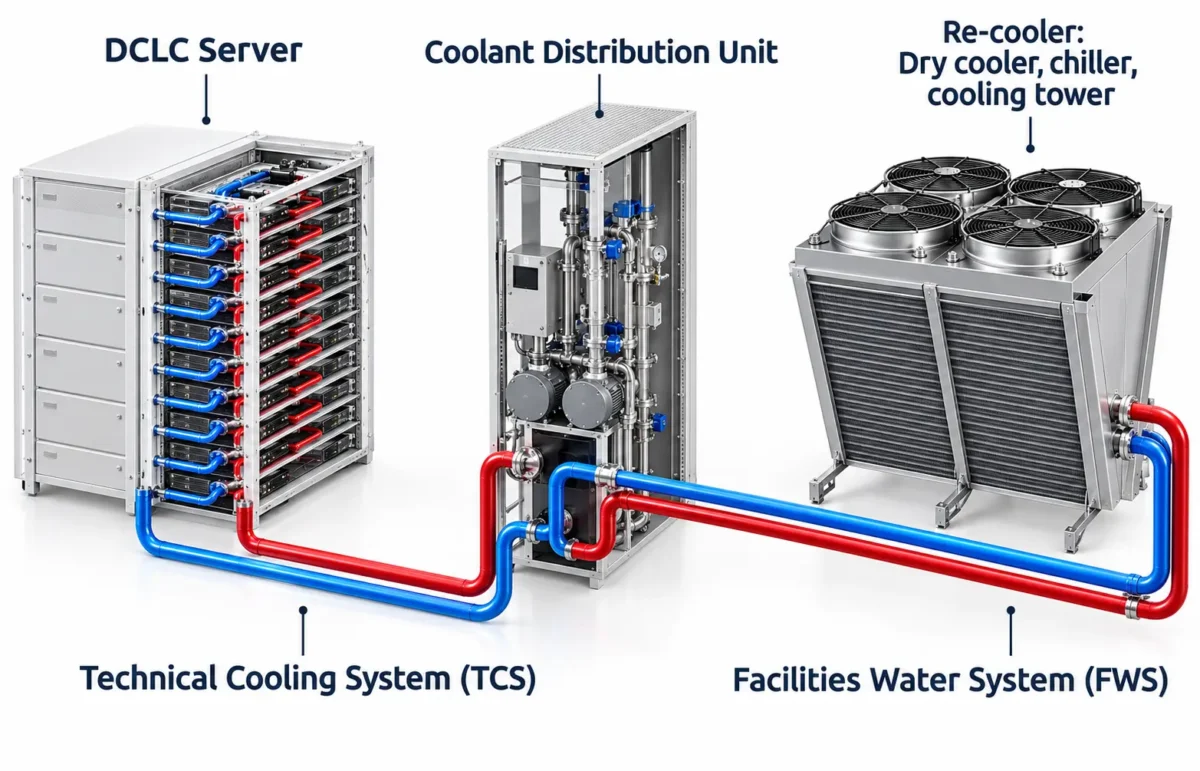
Deploying direct-to-chip cooling at scale means keeping two cooling loops hydraulically separate through a Coolant Distribution Unit.
- The Facility Water System (primary loop): Circulates standard industrial chilled or condenser water from dry coolers or cooling towers to the CDU, under high pressure, using standard industrial metallurgy.
- The Technology Cooling System (secondary loop): Runs from the CDU straight to the server chassis and across the silicon cold plates, through stainless steel or high-purity polymer manifolds, carrying expensive demineralized fluid in a closed loop.
- The approach temperature constraint: Engineers design for the tightest possible approach temperature across the CDU’s heat exchanger, typically 1.5°C to 3°C, because that gap drives PUE down 16. A narrow approach lets secondary loop fluid reject most of its heat to the primary loop without firing up energy-hungry mechanical chillers, which enables full economizer-based free cooling.
- Advanced loop chemistry: Mixing dissimilar metals in the secondary TCS loop risks galvanic corrosion. Operators counter this with copper-passivating inhibitors, specifically Benzotriazole (BTA), which forms a monomolecular protective layer over copper surfaces, blocks copper ion leaching, and stops galvanic action 16.
The Post-PFAS Material Shift and Pumping Power Ratio Penalties
Some cooling systems submerge the entire server board in a liquid that boils on contact with hot components, carrying heat away as vapor. That liquid has to meet a strict bar: electrically inert, stable at high temperature, and safe around live circuitry. For years, the fluids that cleared that bar were fluorinated chemicals.
- The supply chain collapse: The fluorinated fluids used in two-phase boiling are classified as PFAS, so-called forever chemicals. Facing multi-billion-dollar litigation, 3M announced in 2022 that it would exit all PFAS manufacturing by the end of 2025, and completed that phase-out on schedule 33. That single decision eliminated the global supply chain for two-phase immersion fluids.
- The pivot to synthetic hydrocarbons: Operators pivoted toward single-phase synthetic hydrocarbons and ester-based dielectric fluids, and peer-reviewed testing across 15 candidate fluids confirms these substitutes trade PFAS’s chemical stability for a new constraint: dynamic viscosity is now the dominant factor limiting cooling performance 34.
- The viscosity challenge: In controlled testing at an OVHcloud data center, when the kinematic viscosity of synthetic hydrocarbon fluid roughly doubled across three commercial products, from 4.6 to 9.8 mPa·s, cooling performance dropped by approximately 6%, and the fluid’s share of total cooling demand rose from 19% to 25% 35. Viscosity climbs sharply as temperature drops, so the problem compounds in cold climates.
- The parasitic load: At cold start-up, with synthetic hydrocarbon fluid near 15°C, thickness raises torque demand on pump motors. Engineers respond with oversized variable-frequency drive pumps and larger-diameter piping, a workaround that directly reduces the efficiency gains the facility was chasing.
Structural and Foundational Constraints
Data center floors were engineered for a different era of computing. Traditional enterprise racks were light enough that a raised floor, elevated tiles resting on a steel grid, could distribute their weight safely. AI hardware breaks that assumption entirely.
- Raised floor limitations: Standard enterprise raised floors, 24 to 36 inches deep, are typically rated between 150 and 250 pounds per square foot of static load, roughly 730 to 1,220 kg/m², per the ANSI/TIA-942 data center design standard 36.
- The AI weight footprint: A fully populated GB200 NVL72 rack alone exerts a static load near 470 pounds per square foot, about 2,300 kg/m², already close to triple what a standard raised floor is rated to carry, before accounting for the additional weight of copper busbar and cabling, in-rack CDU pumps, and coolant reservoirs 37.
- The slab-on-grade mandate: Multi-megawatt CDUs, with their heavy stainless steel pumps and fluid reservoirs, add further concentrated load that standard raised flooring was never engineered to bear. This mismatch between legacy floor ratings and AI rack density is why new AI facility construction increasingly favors reinforced concrete slab-on-grade foundations over traditional raised-floor construction.
Conclusion
AI compute growth has broken the old link between IT deployment and facility construction. Grid interconnection queues, permitting battles and community pushback, supply chain backlogs, hard liquid-to-liquid cooling limits, and floor loads that outstrip legacy raised-floor ratings are compounding at the same time. Each one now counts as a constraining factor on its own.
Navigating the 2026-to-2030 cycle means institutional investors, CTOs, and design engineers have to drop legacy data center topologies. That means locking in medium-voltage distribution equipment years before the GPUs even ship, treating community opposition, flood exposure, and insurance requirements as site-selection criteria rather than afterthoughts, replacing utility dependency with behind-the-meter generation, swapping forced air handling for micro-filtered direct liquid cooling, and building on reinforced concrete slabs rated for extreme loads. Chip access will not determine which companies lead the AI infrastructure buildout. Mastery of physics, fluid dynamics, grid interconnection, and the communities hosting these facilities will.
How Yamna Unlocks the Future of AI Infrastructure
At Yamna, we believe the solution lies in integrating energy and compute from the start. Yamna is a specialized Power-to-X platform developing green molecules and digital infrastructure projects worldwide.
Our latest publication explores how integrating renewable power, energy storage, and data centers speeds up deployment and improves reliability and resilience, changing how new data center projects get designed and sited.
Compute-first planning is giving way to power-and-compute integration across the industry. If you’re thinking about the future of AI infrastructure, energy transitions, and digital growth, this is a conversation worth having.
We welcome the opportunity to connect and exchange perspectives.
Frequently Asked Questions
Why AI Hardware Needs Liquid Cooling Past 50kW per Rack?
Accelerated AI hardware needs liquid cooling because high-density GPU racks generate 100 to 140 kW of heat, well past what convective air can dissipate. Air cooling hits a hard limit at 30 to 50 kW per rack; push more air than that through a cabinet and fan parasitic loads and acoustic problems follow 16.
FWS vs. TCS: The Two Loops in Direct-to-Chip Cooling
The Facility Water System is an unrefined primary loop circulating industrial water to external towers. The Technology Cooling System is a secondary closed loop delivering pharmaceutical-grade demineralized fluid directly to silicon cold plates. A Coolant Distribution Unit keeps the two hydraulically separate to manage the narrow approach temperature.
How Do GPU Workloads De-Rate Transformers to 65% Capacity?
High-density GPU workloads generate severe total harmonic distortion through their non-linear power supplies, producing eddy currents and stray load losses that overheat standard transformers fast. To avoid insulation breakdown, operators de-rate standard substation units to 65% capacity or source scarce, long-lead-time K-Factor transformers instead.
How Post-PFAS Fluids Change Immersion Cooling Pumps
The shift from fluorinated fluids to single-phase synthetic hydrocarbons brings high kinematic viscosity at low facility water temperatures, which raises hydraulic resistance across the loop. That thickness drives up the Pumping Power Ratio, forcing engineers to install higher-horsepower, variable-frequency drive pumps and rework cold start-up torque parameters.
Why Do Multi-Story Data Centers Risk Piping Cavitation?
Multi-story liquid-cooled facilities face vertical piping cavitation when volumetric expansion in high-density cooling loops causes pressure drops at elevation, creating localized gas pockets. When those micro-bubbles reach a high-horsepower CDU pump impeller, they implode and pit the internal metal, which is why these systems need high-capacity thermal expansion tanks and active air elimination.
Does Benzotriazole Actually Stop Galvanic Corrosion in TCS Loops?
Benzotriazole works as a copper-passivating corrosion inhibitor in secondary Technology Cooling System loops. It forms a monomolecular protective barrier directly over copper cold plates, blocking chemical interaction between dissimilar loop metals. That single layer halts galvanic corrosion, stops copper ion leaching, and prevents conductivity spikes 16.
Why Are DRUPS Replacing Battery UPS in AI Data Centers?
Transient AI workloads push facilities away from conventional battery-backed static UPS systems and toward Diesel Rotary Uninterruptible Power Supplies. Static solid-state inverters suffer harmonic feedback degradation under sub-second GPU current spikes. DRUPS systems use flywheel inertia instead, delivering zero-millisecond transfer and absorbing instantaneous hundred-megawatt load steps safely 2930.
How the EU Energy Efficiency Directive Changes PUE Metrics?
The EU’s Energy Efficiency Directive disrupts legacy PUE metrics by forcing large digital infrastructure operators to actively execute and report waste-heat recovery instead of simply minimizing nominal power losses. That regulatory shift changes the thermodynamic target: engineers now design high-temperature TCS loops that export fluid above 60°C to interface with municipal district heating networks.
Footnotes
1 - International Energy Agency (IEA) — Electricity 2024: Analysis and Forecast to 2026
2 - McKinsey & Company — How Data Centers and the Energy Sector Can Sate AI's Hunger for Power
3 - North American Electric Reliability Corporation (NERC) — Systemic Grid Reliability Operating Assessments
4 - IEEE Standards Association — IEEE 2800-2022: Interconnection Standards for Large-Scale Dynamic Inverter Payload
5 - IEEE Standards Association — IEEE C57.110-2018: Recommended Practice for Establishing Liquid-Immersed and Dry-Type Power and Distribution Transformer Capability When Supplying Nonsinusoidal Load Currents
6 - Engineering News-Record (ENR) — The $150-Billion US Power Boom Has a Reality Problem. September 2026
7 - Akin Gump (AFS Law) — Data Centers and Land Use: Public Opinion and Action. May 2026
8 - City of Madison — Temporary Data Center Moratorium. January 2026
9 - Reuters — New York Becomes the First State to Impose a Data Center Moratorium. July 2026
10 - City of Malden — Legislation Detail, File #252-26: One-Year Data Center Permitting Moratorium. May 2026
11 - WNEP — Olyphant Passes Six-Month Pause on Data Center Development. April 2026
12 - CBS News Texas — Data Center Rezoning Request Denied in Prosper Amid Community Backlash. September 2026
13 - Crowell & Moring — Data Center Noise Litigation 2026: Plaintiffs' Bar Targets AI Infrastructure
14 - WilmerHale — Data Centers in Court: The Emerging Wave of Nuisance, Environmental and Land Use Litigation
15 - Brookings Institution — Data Center Moratoriums Are Not a Substitute for Oversight
17 - Microsoft — Inside Microsoft's Two-Decade Push to Cut Water Intensity While Scaling for Growth. June 2026
18 - Vertiv — Optimizing Water Usage Effectiveness for Data Centers. September 2025
19 - Federal Emergency Management Agency (FEMA) — Flood Zones, National Flood Insurance Program Glossary
20 - Telecommunications Industry Association (TIA) — ANSI/TIA-942 Telecommunications Infrastructure Standard for Data Centers
21 - Google Cloud — Incident Report: Multiple Google Cloud Services in the europe-west9 Region Were Impacted. April 2023
22 - Allianz Commercial — The Data Center Construction Boom: Risks and Claims Trends
23 - Vertiv — Vertiv Reports Strong Orders, Sales, and EPS Growth / Vertiv Sets Clear Sales Growth Targets for 2026. July 2025
25 - Schneider Electric — Schneider Electric Plans to Invest Over $700 Million in the U.S.. November 2025
26 - Wood Mackenzie — Transformer Troubles: Manufacturing and Policy Constraints Hit US Transformer Supply. August 2025
27 - European Union — Regulation (EU) 2024/573 (F-Gas Regulation), Article 13.9, Official Journal of the European Union
28 - Schneider Electric — SF6-Free Medium Voltage Innovation Reports
29 - Vertiv Holdings Co. — Form 10-K Securities and Exchange Commission Annual Filing
30 - Eaton Corporation — Quarterly Performance and Financial Backlog Disclosures
31 - Uptime Institute — Global Data Center Survey and Intel Analytics
32 - NVIDIA Corporation — NVIDIA GB200 NVL72 Product Specifications
33 - 3M Company — 3M to Exit PFAS Manufacturing by the End of 2025
34 - Aflatounian, S. et al. — Comparative Evaluation of Dielectric Liquids for Single-Phase Immersion Cooling of Electronics, International Journal of Heat and Mass Transfer, Vol. 265, Article 128765. Sept. 2026
35 - Hnayno, M., Chehade, A., Klaba, H., Polidori, G., Maalouf, C. — Experimental Investigation of a Data-Centre Cooling System Using a New Single-Phase Immersion/Liquid Technique, Case Studies in Thermal Engineering, Vol. 45, Article 102925 (OVHcloud / University of Reims Champagne-Ardenne). 2023
36 - Telecommunications Industry Association (TIA) — ANSI/TIA-942 Telecommunications Infrastructure Standard for Data Centers
37 - HPE (Hewlett Packard Enterprise) — NVIDIA GB200 NVL72 by HPE QuickSpecs. August 2026
38 - Associated Builders and Contractors (ABC) / Bisnow — Data Centers, Immigration Action Add To Construction Labor Shortage.. January 2026